
ITSIBio News – Monthly Newsletter by ITSI Biosciences
With over 21 years of experience, ITSI Biosciences continues to support innovation in life science research through comprehensive analytical services and advanced sample preparation technologies.
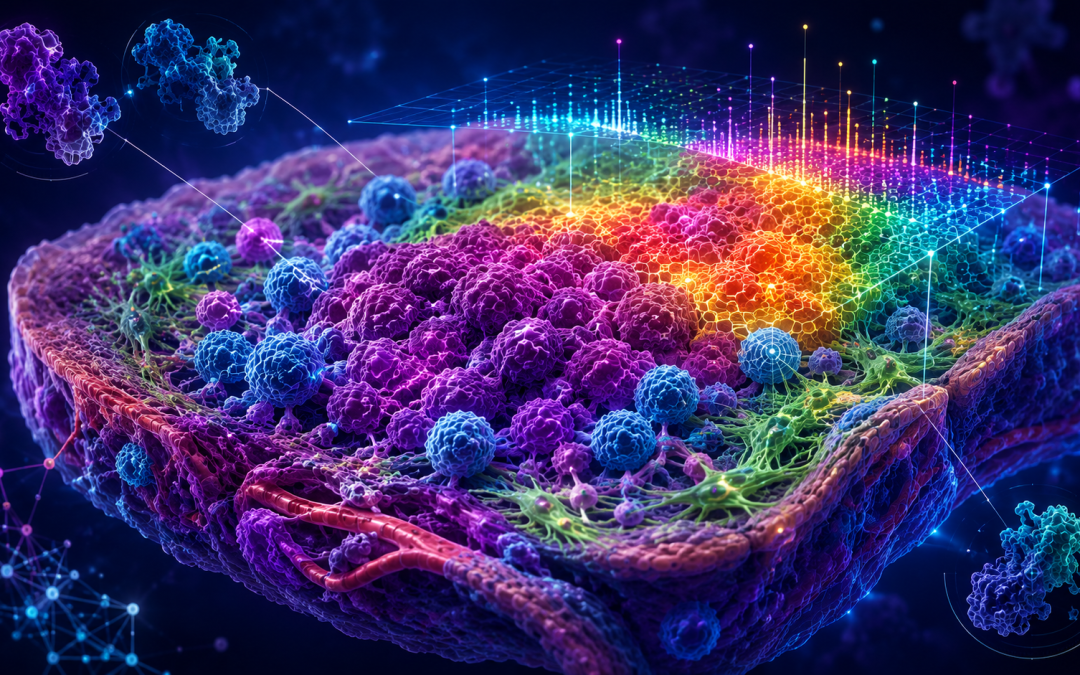
Understanding cancer has moved far beyond studying tumor cells in isolation. Today, the tumor microenvironment (TME), a complex ecosystem of cancer cells, immune cells, stromal components, and signaling molecules, is recognized as a critical driver of disease progression, metastasis, and therapeutic response. Recent advances in spatial proteomics are transforming how researchers explore this intricate landscape, offering unprecedented insights into protein expression within its native spatial context.
Why Spatial Proteomics Matters
Traditional proteomics approaches provide powerful quantitative data but often lose spatial information due to bulk sample processing. Spatial proteomics bridges this gap by preserving the localization of proteins within tissue architecture. This is particularly vital in cancer research, where the spatial arrangement of immune cells and tumor cells can determine treatment outcomes, especially in immuno-oncology.
By mapping protein expression directly within tissue sections, researchers can:
a) Identify distinct cellular neighborhoods within tumors
b) Characterize immune infiltration patterns
c) Detect biomarker gradients linked to therapy resistance
d) Understand cell-to-cell interactions driving tumor progression
Technology Driving the Revolution
Recent innovations in mass spectrometry and multiplexed imaging have accelerated spatial proteomics capabilities. Techniques such as LC-MS/MS-based spatial profiling, Luminex xMAP, and Tandem Mass Tag (TMT) quantitation now enable high-resolution, multiplexed protein analysis across tissue regions.
Laser capture microdissection (LCM) combined with advanced proteomic workflows allows for precise isolation of specific regions of interest, such as tumor margins or immune niches. Meanwhile, emerging workflows integrate proteomics with histological imaging, providing a powerful multimodal approach to tissue analysis.
Applications in Tumor Microenvironment Research
Spatial proteomics is unlocking new possibilities in cancer research, including:
a) Immuno-oncology insights: Mapping immune cell distribution and activation states within tumors to predict response to checkpoint inhibitors
b) Biomarker discovery: Identifying spatially resolved protein signatures associated with prognosis or therapeutic resistance
c) Drug development: Evaluating how candidate drugs modulate specific regions within the tumor microenvironment
d) Precision medicine: Enabling patient stratification based on spatial protein expression patterns
ITSI Biosciences: Enabling Spatial Discovery
At ITSI Biosciences, we leverage over two decades of expertise in bioanalytical services to support cutting-edge spatial proteomics research. Our integrated workflows combine LCM, 2D-DIGE, advanced mass spectrometry platforms, robust sample preparation, and expert data analysis to deliver high-quality, spatially resolved proteomic data.
We support a wide range of sample types including FFPE tissues, fresh frozen samples, and complex biological matrices, ensuring flexibility for diverse research needs. From experimental design through data interpretation, our team works closely with clients to extract meaningful insights from every dataset.
Looking Ahead
As spatial proteomics technologies continue to evolve, their impact on cancer research will only deepen. The ability to visualize protein expression within the tumor microenvironment is paving the way for more precise diagnostics, more effective therapies, and ultimately, better patient outcomes.
At ITSI Biosciences, we are proud to be at the forefront of this transformation, that empowers researchers with the tools and expertise needed to decode the complexity of cancer.
Stay informed. Stay innovative. Stay connected with ITSIBio News.
Next Issue: Proteomics in Microbiome Research
Connect With Us
Email: itsi@itsibio.com
Phone: +1-814-262-7331
Visit: www.itsibio.com
