
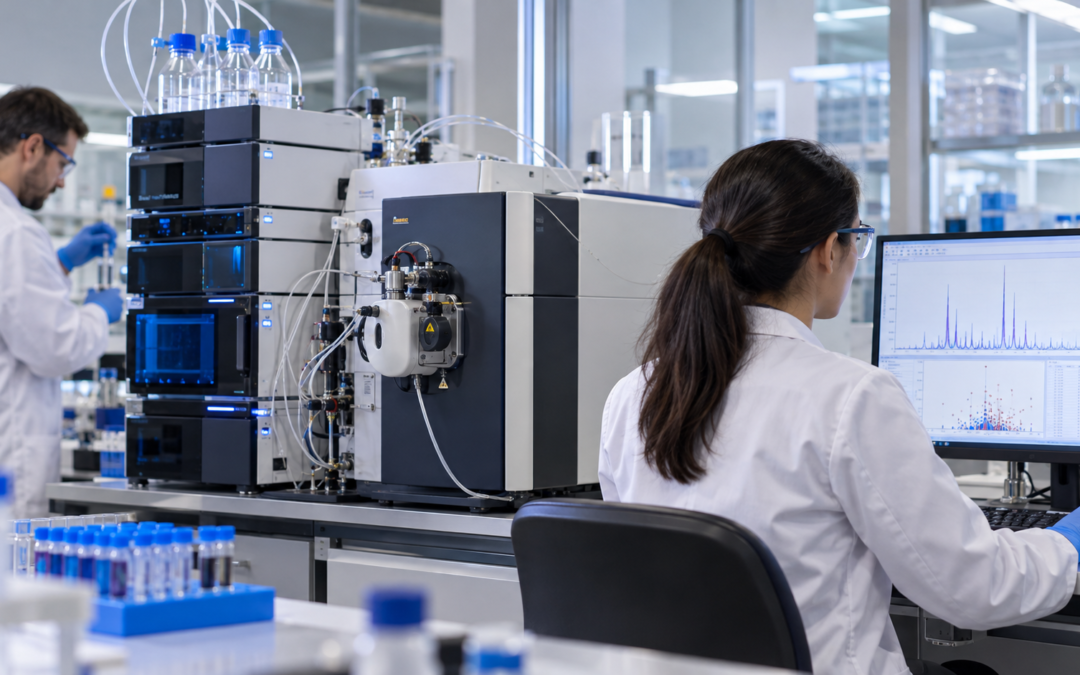
Proteins are dynamic molecules that reflect what is happening inside cells, tissues, and biological systems. Understanding which proteins are present, how their abundance changes, and whether they have been modified can provide valuable insight into disease mechanisms, drug responses, biomarkers, and biological pathways.
Liquid chromatography-tandem mass spectrometry (LC-MS/MS) is one of the most powerful tools available for answering these questions. From identifying proteins in complex samples to comparing protein abundance across experimental conditions, LC-MS/MS has become an essential technology in modern proteomics research.
What Is LC-MS/MS?
LC-MS/MS combines liquid chromatography (LC) with tandem mass spectrometry (MS/MS). Liquid chromatography first separates peptides within a sample. The mass spectrometer then measures and fragments selected peptide ions, generating spectra that can be analyzed to help determine peptide sequences and identify their corresponding proteins.
This combination allows researchers to investigate proteins within both relatively simple and highly complex biological samples. Mass spectrometry-based proteomics can also provide information about protein abundance and modifications that may influence protein function. For a broader overview of how mass spectrometry is used in protein research, see Thermo Fisher Scientific’s overview of protein mass spectrometry.
1. What Proteins Are in My Sample?
One of the most common applications of LC-MS/MS is protein identification. After proteins are enzymatically digested into peptides, LC-MS/MS generates fragmentation data that can be compared with protein sequence databases to identify proteins represented in the sample.
At ITSI-Biosciences, LC-MS/MS protein identification services can support purified proteins, gel bands, protein mixtures, and complex biological samples.
This can be particularly valuable when researchers need to identify an unknown protein, characterize proteins isolated during an experiment, investigate complex protein mixtures, or confirm the identity of a protein of interest.
2. How Does Protein Abundance Change Between Samples?
LC-MS/MS can go beyond protein identification and help researchers determine how protein abundance differs between experimental conditions.
For example, researchers may want to compare:
- Disease versus healthy samples
- Treated versus untreated cells
- Drug-responsive versus drug-resistant samples
- Different experimental time points
- Multiple biological conditions or treatment groups
ITSI-Biosciences offers both Tandem Mass Tag (TMT) multiplexing and label-free quantitative proteomics. TMT-based workflows enable relative comparison of multiple samples within a multiplexed experiment, while label-free approaches provide an alternative for measuring protein abundance without chemical or isotopic labeling.
These approaches can support applications such as biomarker discovery, drug development, comparative proteomics, and biological pathway analysis. Learn more about ITSI’s quantitative LC-MS/MS and proteomics services.
3. Has the Protein Been Modified?
Proteins frequently undergo post-translational modifications (PTMs) after they are produced. These modifications can affect protein activity, localization, stability, interactions, and signaling.
High-resolution LC-MS/MS can help identify modified peptides and determine the location of modifications within a protein sequence. Depending on the project, PTM analysis may investigate modifications such as:
- Phosphorylation
- Acetylation and methylation
- Ubiquitination and SUMOylation
- Glycosylation
- Oxidation
Identifying these changes can provide researchers with a deeper understanding of protein regulation and the molecular mechanisms underlying a biological response.
4. What Can LC-MS/MS Reveal About Biological Differences?
The real value of LC-MS/MS often comes from connecting protein-level measurements to a larger biological question.
Changes in protein expression or modification can help researchers investigate potential biomarkers, characterize disease-associated pathways, study responses to therapeutic compounds, identify candidate drug targets, and better understand cellular mechanisms.
For projects requiring an additional protein-separation strategy, ITSI-Biosciences also provides 2D-DIGE with LC-MS/MS protein identification for applications including comparative proteomics, biomarker discovery, and host cell protein analysis.
From Sample to LC-MS/MS Results
A successful proteomics experiment begins well before a sample enters the mass spectrometer. Sample quality, preparation, digestion, chromatographic separation, instrument analysis, database searching, and data interpretation can all influence the final results.
ITSI-Biosciences provides an integrated LC-MS/MS workflow that can include sample preparation, reduction and alkylation, tryptic digestion, nano-LC separation, high-resolution mass spectrometry, protein identification, and data analysis.
Researchers can therefore select the level of support appropriate for their project, from analysis of prepared samples to more comprehensive sample-to-result proteomics workflows.
Choosing the Right LC-MS/MS Approach for Your Research
The appropriate LC-MS/MS strategy depends on the question you are trying to answer. A project focused on identifying an unknown protein may require a different workflow from a study comparing protein expression across multiple treatment groups or mapping specific post-translational modifications.
Defining the biological question, sample type, number of experimental groups, desired level of quantitation, and downstream analysis requirements before beginning the experiment can help determine the most appropriate approach.
LC-MS/MS Proteomics Services at ITSI-Biosciences
ITSI-Biosciences provides high-resolution LC-MS/MS and proteomics services to researchers in academia, biotechnology, pharmaceutical research, and other life science fields. Our capabilities include protein identification, TMT-based relative quantitation, label-free quantitative proteomics, PTM analysis, sample preparation, and data analysis.
We work with clients across the United States and internationally, allowing researchers to ship samples directly to our Pennsylvania laboratory for analysis.
Have a protein sample or proteomics project you would like to discuss?
Explore our LC-MS/MS and proteomics services and request a project quote.
You can also contact ITSI-Biosciences at itsi@itsibio.com or call (814) 262-7331 to discuss your project.
