
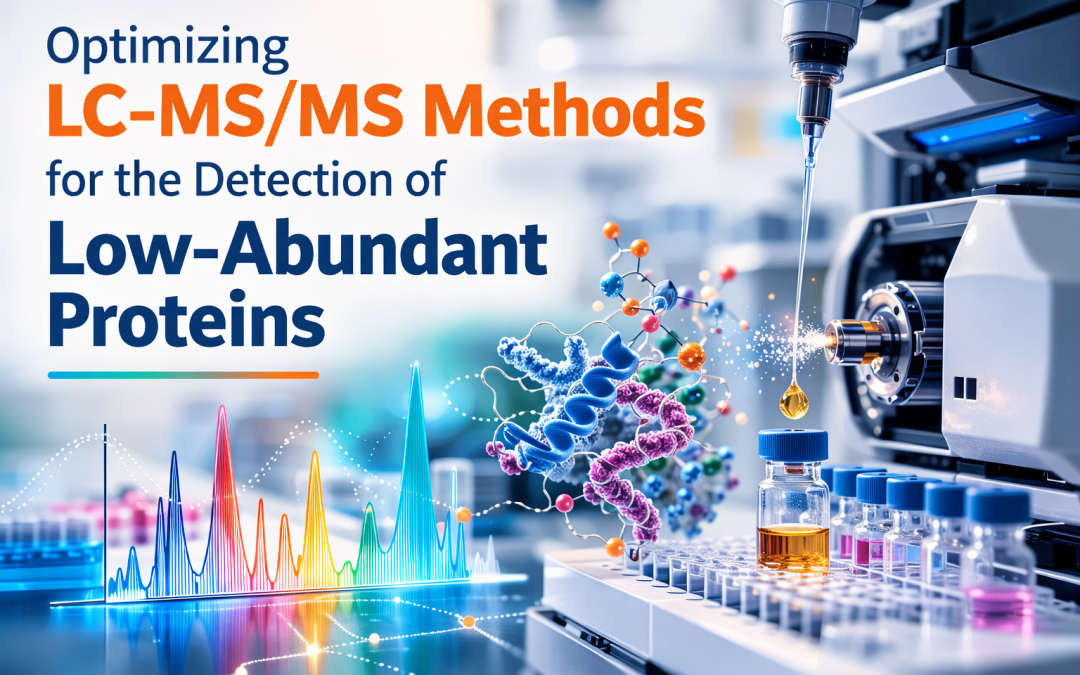
In modern proteomics, the ability to confidently detect and quantify low-abundant proteins can determine the success of biomarker discovery, target validation, and translational research. At ITSI Biosciences, we routinely support clients across biopharma, academia, and government institutions in designing and optimizing LC-MS/MS workflows that maximize sensitivity without compromising reproducibility.
This month, we explore practical and strategic approaches to optimizing LC-MS/MS methods for detecting low-abundance proteins in complex biological samples.
Why Low-Abundance Proteins Are Challenging
Low-abundant proteins are often masked by highly abundant species such as albumin in plasma or structural proteins in tissue lysates. Analytical challenges include limited dynamic range of detection, Ion suppression in complex matrices, Incomplete digestion or peptide loss, Insufficient chromatographic separation and Suboptimal instrument parameters. Overcoming these limitations requires optimization across the entire workflow—from experimental design to data interpretation.
1. Strategic Experimental Design
Optimization begins before the sample reaches the mass spectrometer.
Define the Objective Clearly
- Discovery vs. targeted quantitation?
- Relative vs. absolute quantification?
- Known targets or exploratory profiling?
For low-abundance proteins, targeted approaches (e.g., SRM/MRM or PRM) often provide superior sensitivity compared to data-dependent acquisition (DDA).
Increase Biological Signal
- Enrich specific cell populations
- Use fractionation strategies
- Optimize sample collection and storage conditions
Careful experimental design ensures the analytical platform is not compensating for preventable upstream losses.
2. Sample Preparation: The Foundation of Sensitivity
Sample preparation is often the most critical determinant of success.
Depletion of High-Abundance Proteins
In plasma or serum studies, depletion of albumin and immunoglobulins can significantly enhance detection of low-level biomarkers.
Enrichment Strategies
- Immunoprecipitation (IP)
- Affinity capture
- Subcellular fractionation
- Phospho- or glyco-enrichment
Efficient Protein Digestion
- Optimize enzyme-to-protein ratios
- Control digestion time and temperature using kits such as ProDM produced by ITSI Biosciences
- Evaluate surfactant compatibility
Even minor inefficiencies during digestion can disproportionately affect low-copy proteins.
3. Chromatographic Optimization (LC)
Liquid chromatography plays a critical role in reducing complexity before MS detection.
Column Selection
- Smaller particle sizes improve separation efficiency
- Narrow-bore columns enhance sensitivity
Gradient Optimization
- Longer gradients improve peptide separation
- Shallower gradients reduce co-elution and ion suppression
Sample Loading
Avoid column overloading, which can suppress signals of low-abundance peptides.
4. Mass Spectrometry Parameter Optimization (MS/MS)
Fine-tuning MS settings significantly improves low-level detection.
Key Parameters to Optimize:
- Spray voltage and source conditions
- Resolution settings
- AGC targets
- Maximum injection time
- Collision energy
For low-abundance detection, increasing injection time can improve signal accumulation, though this must be balanced against scan speed. Advanced platforms combined with optimized workflows, such as Tandem Mass Tag (TMT) quantitation enable multiplexing while preserving sensitivity.
5. Fractionation and Multi-Dimensional Approaches
When dynamic range is limiting, fractionation can dramatically increase proteome coverage:
- High-pH reverse phase fractionation
- Strong cation exchange (SCX)
- Off-line 2D separations using kits like ProFEK developed by ITSI Biosciences
Although fractionation increases analysis time, it reduces sample complexity and enhances detection of low-abundant species.
6. Quantitative Strategies for Low-Level Proteins
Isobaric Labeling
Multiplex strategies such as Tandem Mass Tag (TMT) improve comparative analysis and throughput.
Targeted Quantitation
- SRM/MRM
- PRM
These approaches provide higher sensitivity and reproducibility for predefined targets.
Complementary Platforms
In some studies, orthogonal validation using technologies such as xMAP bead-based multiplexing from Luminex offered by ITSI Biosciences can confirm low-level protein findings identified by LC-MS/MS.
7. Data Analysis and Interpretation
Low signal intensities require:
- Robust normalization strategies
- Appropriate statistical modeling
- Careful false discovery rate (FDR) control
Optimized bioinformatics pipelines ensure that increased sensitivity does not come at the cost of confidence.
8. End-to-End Optimization: An Integrated Approach
True sensitivity gains are achieved when all elements are optimized together:
a) Experimental design
b) Sample preparation
c) Chromatography
d) Mass spectrometry parameters
e) Quantitative strategy
f) Data analysis
At ITSI Biosciences, our integrated proteomics platform, including LC-MS/MS, 2D-DIGE, spatial proteomics, and multiplex immunoassays allows us to tailor workflows to each study’s unique biological and analytical challenges. We support every sample type, including solid tissue, cells, blood, urine, plant material, and FFPE tissue, ensuring that valuable insights are captured from even the most complex matrices.
Key Takeaways
- Sensitivity is built through workflow integration, not a single parameter change.
- Sample preparation is often the most critical optimization step.
- Targeted MS methods offer superior detection for known low-abundance proteins.
- Fractionation and multiplexing can expand detectable dynamic range.
- Data interpretation must be as rigorous as analytical optimization.
Partner with ITSI Biosciences
Detecting low-abundance proteins requires experience, precision, and methodological rigor. Whether supporting drug discovery, biomarker identification, or translational research, ITSI Biosciences provides end-to-end analytical services designed to extract meaningful biological insight from every experiment.
For more information about optimizing your proteomics workflows, contact our scientific team to discuss your project needs.
Connect With Us
Email: itsi@itsibio.com
Phone: +1-814-262-7331
Visit: www.itsibio.com
