
Protein Biomarker Discovery: A Researcher’s Guide
Introduction
Protein biomarkers are transforming biomedical research by helping scientists detect disease earlier, monitor treatment response, and identify new therapeutic targets. Unlike DNA, which provides the genetic blueprint, proteins reflect what is actively happening within cells and tissues, making them valuable indicators of health and disease.
Advances in proteomics technologies such as LC-MS/MS, Luminex xMAP, and targeted protein analysis have made it possible to identify and quantify thousands of proteins with remarkable accuracy. As a result, protein biomarker discovery has become an essential component of modern drug development, translational research, and precision medicine.
This guide explores the biomarker discovery process, the technologies involved, and how researchers can design successful studies.
What Is Protein Biomarker Discovery?
Protein biomarker discovery is the process of identifying proteins that provide measurable information about a biological condition or disease. These biomarkers can help researchers:
- Detect diseases earlier
- Understand disease mechanisms
- Monitor treatment response
- Identify therapeutic targets
- Support precision medicine
Because protein expression changes throughout the course of disease, biomarkers often provide real-time insight into biological processes that cannot be observed through genetic analysis alone.
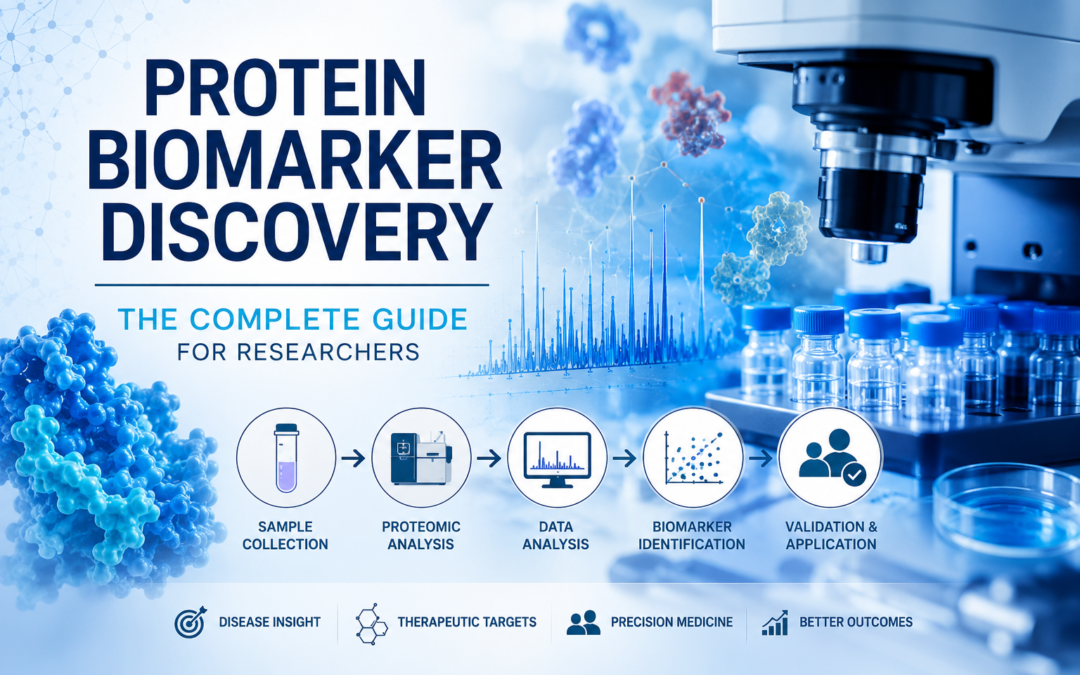
The Biomarker Discovery Workflow
Successful biomarker discovery typically follows a structured workflow:
Study Design
Every project begins with a clearly defined research question. Researchers should carefully select study populations, determine sample size, and identify potential biological variables that could influence protein expression.
Sample Collection
High-quality samples are essential for reliable results. Common sample types include serum, plasma, tissue, urine, cerebrospinal fluid (CSF), and FFPE tissue.
Protein Analysis
Researchers use advanced analytical platforms to identify and quantify proteins associated with disease. Popular technologies include:
- LC-MS/MS for large-scale protein identification
- Luminex xMAP for multiplex protein analysis
- 2D-DIGE for comparative protein expression
- ELISA and Western Blot for biomarker validation
Data Analysis and Validation
Once candidate biomarkers have been identified, bioinformatics and statistical analysis help determine which proteins are biologically meaningful. Promising candidates are then validated in larger, independent sample sets before being considered for clinical or research applications.
Technologies Driving Modern Biomarker Discovery
Modern proteomics combines multiple complementary technologies.
LC-MS/MS
Liquid Chromatography-Tandem Mass Spectrometry (LC-MS/MS) is considered the gold standard for large-scale protein identification because it offers exceptional sensitivity, accuracy, and quantitative capabilities.
Luminex xMAP
Luminex technology enables researchers to measure multiple proteins simultaneously from a single sample, making it ideal for cytokine profiling and immune response studies.
Targeted Proteomics
After discovery, targeted proteomics methods such as SRM, MRM, and PRM allow researchers to accurately quantify specific biomarker candidates across larger study populations.
Bioinformatics
Proteomics generates large, complex datasets. Bioinformatics tools help researchers identify differentially expressed proteins, perform pathway analysis, visualize results, and uncover meaningful biological patterns.
Common Challenges
Protein biomarker discovery presents several challenges, including:
- Biological variability between patients
- Poor sample quality
- Technical variability
- Small study populations
- Complex data analysis
- Lack of independent validation
Standardized workflows, rigorous quality control, and experienced scientific collaboration help overcome these challenges and improve reproducibility.
Why Many Researchers Partner with Proteomics Experts
Building and maintaining advanced proteomics capabilities requires significant investment in instrumentation, specialized personnel, and computational resources.
Partnering with an experienced proteomics laboratory offers several advantages:
- Access to advanced analytical technologies
- Experienced multidisciplinary scientists
- Faster project timelines
- Scalable research support
- Integrated bioinformatics
- High-quality, reproducible data
For many organizations, outsourcing proteomics allows internal teams to focus on scientific discovery while leveraging external expertise for complex analytical workflows.
Why Choose ITSIBIO?
ITSIBIO partners with academic institutions, biotechnology companies, pharmaceutical organizations, and clinical researchers to provide customized proteomics solutions.
Our capabilities include:
- Protein biomarker discovery
- LC-MS/MS analysis
- Luminex xMAP assays
- Targeted proteomics
- Biomarker validation
- Bioinformatics support
- Customized research workflows
From study planning to data interpretation, our scientific team works collaboratively to help researchers generate reliable, publication-ready results.
Conclusion
Protein biomarker discovery continues to play a critical role in advancing biomedical research, drug development, and precision medicine. By combining thoughtful study design, advanced proteomics technologies, and rigorous validation, researchers can uncover meaningful biomarkers that improve our understanding of disease and accelerate scientific innovation.
Whether you’re beginning a new biomarker discovery project or expanding an existing study, partnering with an experienced proteomics team can help you move from complex biological questions to confident scientific answers.
Ready to discuss your research? Contact ITSIBIO to learn how our scientists can support your next biomarker discovery project with customized proteomics solutions.
Frequently Asked Questions
What is protein biomarker discovery?
Protein biomarker discovery is the process of identifying proteins that indicate a biological condition, disease state, or response to treatment. Researchers use advanced proteomics technologies to discover biomarkers that can improve disease diagnosis, drug development, and precision medicine.
Why are protein biomarkers important?
Protein biomarkers provide real-time insight into biological processes because protein expression changes in response to disease, treatment, and environmental factors. They are widely used to detect disease, monitor progression, evaluate treatment response, and identify therapeutic targets.
What technologies are commonly used for protein biomarker discovery?
Common technologies include:
- LC-MS/MS
- Luminex xMAP
- 2D-DIGE
- ELISA
- Western blotting
- Targeted proteomics
- Bioinformatics and data analysis
Researchers often combine multiple technologies to improve biomarker identification and validation.
What samples can be used for protein biomarker discovery?
Depending on the study objectives, researchers commonly analyze:
- Serum
- Plasma
- Whole blood
- Tissue
- FFPE tissue
- Cerebrospinal fluid (CSF)
- Urine
- Saliva
- Cell lysates
The most appropriate sample type depends on the disease being investigated and the analytical methods being used.
What is the difference between biomarker discovery and biomarker validation?
Biomarker discovery focuses on identifying potential protein candidates, while biomarker validation confirms that those candidates are reproducible, biologically relevant, and suitable for research or clinical applications.
How does bioinformatics support biomarker discovery?
Bioinformatics helps researchers process large proteomics datasets, identify differentially expressed proteins, perform pathway analysis, visualize results, and uncover meaningful biological insights that may not be apparent through laboratory analysis alone.
Why do researchers outsource proteomics studies?
Many organizations partner with specialized proteomics laboratories to gain access to advanced instrumentation, experienced scientists, validated workflows, and integrated bioinformatics support without the significant cost of building these capabilities internally.
Can ITSIBIO support custom biomarker discovery projects?
Yes. ITSIBIO works with universities, biotechnology companies, pharmaceutical organizations, healthcare institutions, and research laboratories to provide customized proteomics solutions. Our team supports projects from study design and sample analysis through biomarker validation and data interpretation.
